Lessons in Sobriety that I Learned from my Dogs

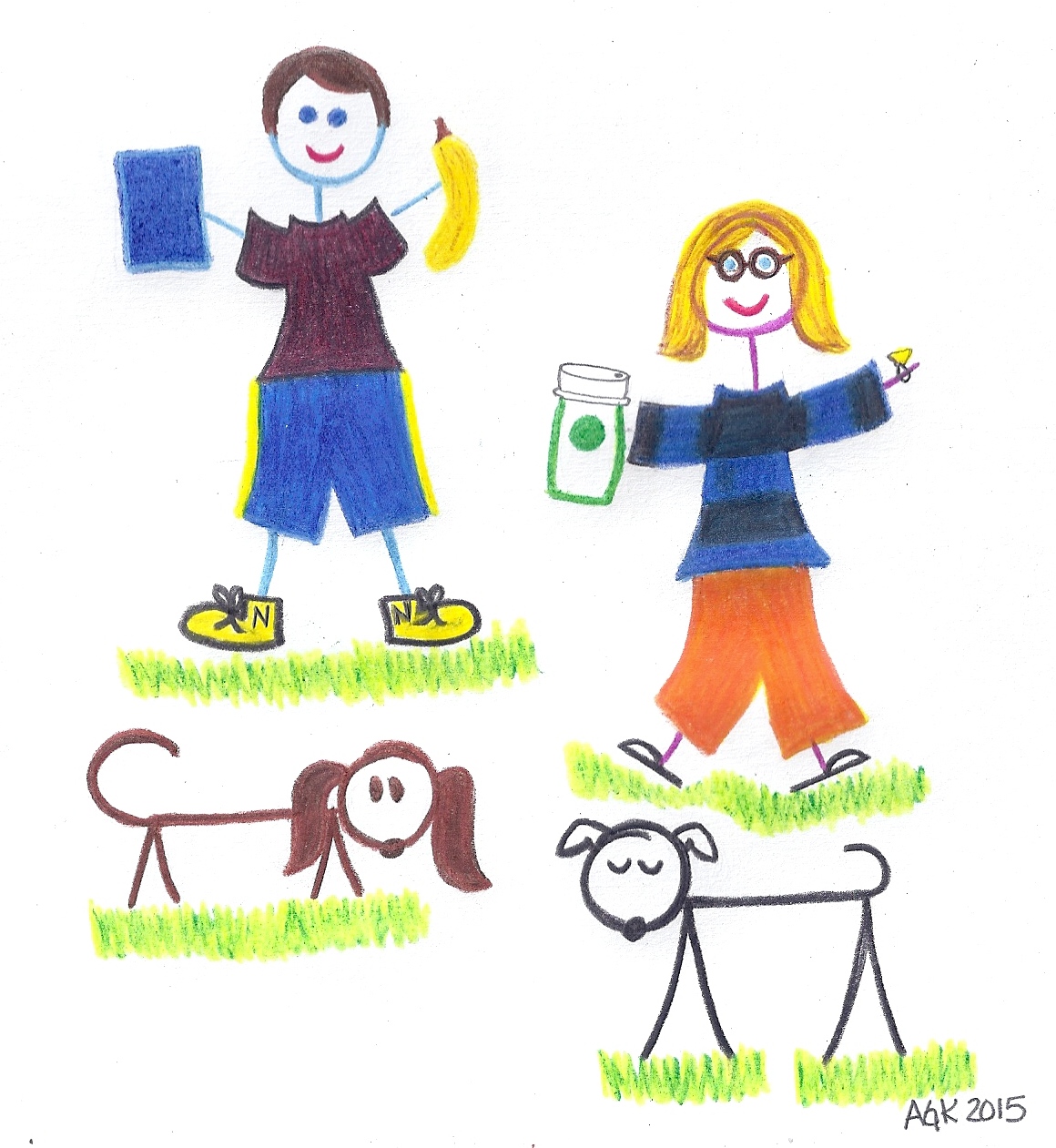
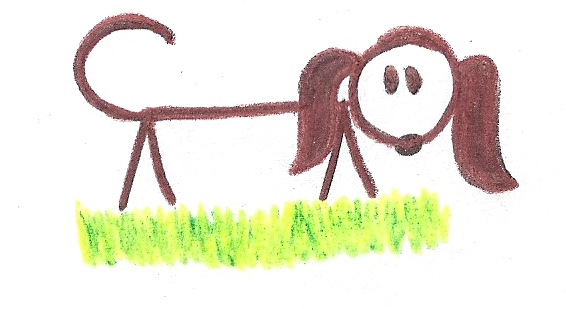
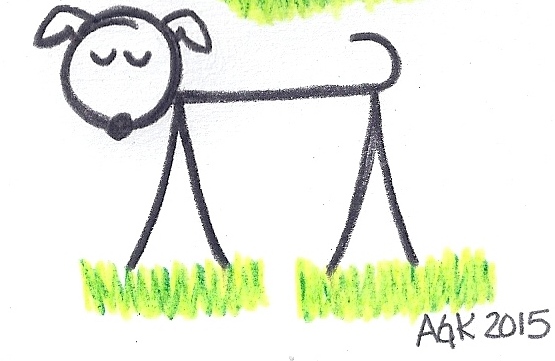
Dio DrawingFluffy Drawing

Anyone who knows me knows that I love my dogs. I got my first puppy, Dionysus, when I had about 2½ years sober. I had moved into a little efficiency apartment in the Heights area of Houston. I was struggling with loneliness and isolation after sober living. One day, a friend in the program posted on Facebook that his dog had a litter. He lived close by and impulsively I thought, “Well, I’ll just drive by and look.” When I picked up the first puppy, she wriggled and squirmed. The second, a shockingly tiny thing with big, fluffy ears promptly fell asleep in my arms. I feel in love instantly. I took her home that day and never looked back.

So today, I bring you: Lessons in Sobriety that I Learned from my Dogs.

Forgiveness: It is embarrassing to say, but I seemingly made it to adulthood with fully grasping the concept of unconditional love and forgiveness. I just didn’t get it. Instead, I judged people. I held them to impossible standards. When they inevitable let me down, I walked away. I rationalized my behavior in the spirit of self-preservation without ever understand the chaos and hurt left in the wake of my actions.

I still had not learned this lesson when I got Dio. I stayed home for the first couple of days I had her, but eventually I had to return to work. I was a server, so my shifts were relatively short, and yet, almost every day, I would come home to damage. She chewed through my cable wire, speaker wires, multiple pairs of shoes, my couch cushions, and my linoleum tiled floor. One day she even ate the side of my door. I tried to protect my belongings. I bought her chew toys and bones to no avail. Every single day, everything I owned laid in perpetual danger of being destroyed. And every day it seemed I would come home to some new and totally incomprehensible form of destruction. I would get so angry, Dio would momentarily hang her head. I would instantly forgive her; she would instantly forgive me. One day, I realized that there was nothing Dio could ever do that would cause me to stop loving her. She taught me how to love unconditionally.

Acceptance: My little apartment had floor to ceiling windows in the front of the apartment. It was one of the selling points of the apartment. But I had not envisioned owning a puppy at that point. Now, had the windows been a normal height, my tiny Dachshund would never have been able to bark at the mailman, people walking their dogs, the neighbor’s cat, my landlord, bicycles, or any of the other countless distractions that exist in the Heights.

The barking is frustrating; I won’t lie. It tends to happen the most just as I am lying down for a nap. As much as I go “Dio! Shush!” She does not listen to me. Do you know why? Because she is a dog. And dogs bark at things. It is in their nature to do so. So, on some level I had to let Dio be Dio, an insanely protective, vicious, barking attack puppy.

Addicts are like that too. We have a shared bond of insecurity and fear, bad judgment and self-centeredness. These shared characteristics are what make us relate so well to each other, and yet, when I see them in you, it drives me crazy. Just sit through a whole meeting for once, dang it! No crosstalk. You can go an hour without smoking. Stop smacking your gum. No need to curse. Eventually, though, I learned that my taking your inventory is not going to do anyone any good. You will not listen to me. Most often, the life lessons we learn are a direct result of our own personal experience, not things told to us by other insanely controlling people. I learned to let addicts be addicts too.

Responsibility: Every family sitcom over the span of television has had the episode where little Johnny brings home a dog. He wants to keep it. The parents have the inevitable conversation about how owning a dog will teach Little Johnny responsibility.

Dogs require a tremendous about of time and money. Before we go any further, let me tell you that I am not coming at this one from a place of moral superiority. My love for my puppies is equally matched by my procrastination. Even as I type this, I know I am a month overdue for their vet appointment.

There is something about a dog, though, that will eventually warm the heart of even the most cold-hearted, miserly, and selfish addict. Anyone who has a problem sharing their resources should get a pet that requires much from them. Having dogs has taught me that my time and money do not always belong to me, that I have cute, lovable, little furry beings that are totally reliant on me for food and safety.

I remember the old Sandra Bullock movie, 28 Days, when they tell her to get a plant. If she could make it a year without the plant dying, she could get a dog. If the dog made it a year without dying, then she could get into a relationship. The movie is terrible, but the sentiment is good.

Learning to be a contributing member of society requires one to give of themselves. Sometimes this is difficult. Other people’s character defects can grind on us. Our own behaviors can push people away. But a dog’s love loyalty ring true. I honestly feel my sobriety today has been improved by the forgiveness and character of my fierce, little dogs.

Dio papertowels

This picture is not photo-shopped. That’s a honest to goodness self-satisfied grin.

Lydia: Thirty Days and a Thousand Nights

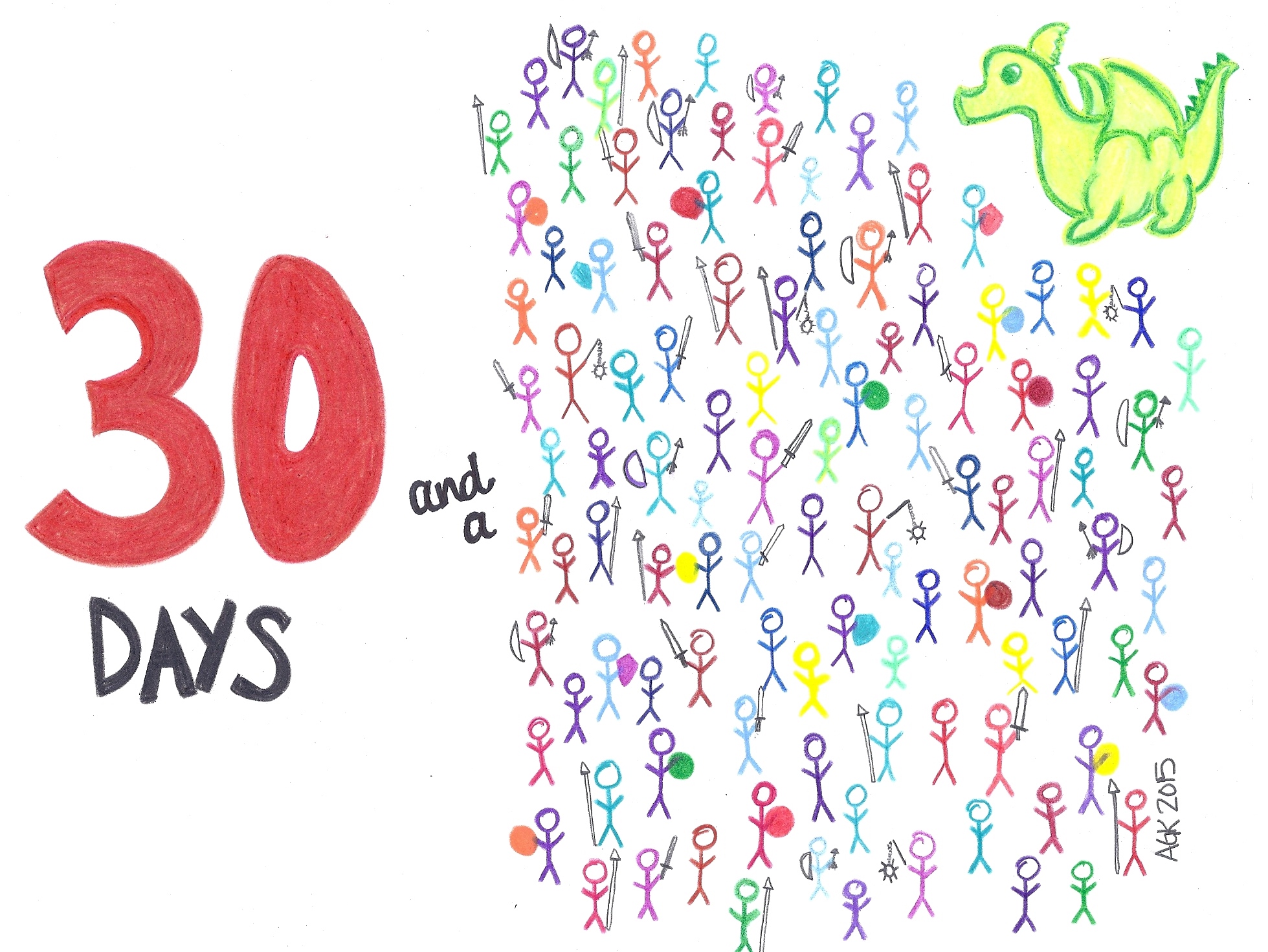
Thirty Days and 1000 KnightsLydia sat in the Starbucks at Echo Lane, sipping her green tea latte, and people watching through the windows. Over the last couple of weeks, Lydia had grown to like her little window seat on the world. It had become part of her new daily ritual along with the 3:15 meeting and the thought, if not the actual practice, of doing yoga.

So, on the day of her thirtieth chip, Lydia sat in her corner and looked upon the world. Echo Lane, Lydia had decided, was an fascinating cross-section of society. Students of Memorial High School, laden down with books and aspirations, filtered through the Starbucks and Baskin Robbin in the free spirit special to youth. It had reminded Lydia how happy she had been before Tuck died. She once had dreams and interests that mattered. She wanted to fly to Paris and sketch where the great artist sketched. She wanted to read the great works of literature, not because it would make her sound more interesting at dinner parties, but because all people should. The students of Echo Lane reminded her that life at one time seem mysterious and adventurous, something to revel in and enjoyed.

The other half of Echo Lane was comprised of the parents of the students. Most were like her, trying their best just to make it through the day. The dog had to go to the groomer. Sally needed a new tutu for dance. The parking lot was a juggernaut of SUVs with Cheerio-ed back seats and varsity club stickers. All those things, she thought, once seemed so important. In the microcosm of Memorial, so much rode on the perception of imperfect perfection, of unaffected beauty. There need to be a certain ease of life that was anything but easy to attain. But they all tried. Lydia had tried.

So, it was in this place that Lydia most often came to reflect on what should have been, what was, and what might be. She looked down upon her notebook where she had been casually tracing over the date. It was her thirtieth day of sobriety. She wondered how such an important day could go completely and utterly unrecognized by the entirety of her world, but that was the case. She had yet to tell any of her friends, nor her children, not even Henry about her sobriety. There was a part of her, she figured, that felt if she told them, it would make it real. One would think admitting one’s faults to oneself would be the hard part, but no… it was the telling to people who already knew, that you knew too. She couldn’t figure out how that could be, but such was life.

Lydia couldn’t help but think about her thirty days. Thirty days. She wanted not to think about it actually. She wanted somehow to be better that that. “Oh, thirty days. Yes, no big deal. Just called my sponsor and read the Big Book, yes, yes.” But it wasn’t like that. It was hard. She was embarrassed that only a couple of days ago the desire to drink came over her in such a torrent that she tore through her house, and had she found anything, she surely would have drank it. The thirty days felt a bit fraudulent. She felt she had failed.

Lydia did not know how long she had been lying on the floor of her kitchen that day, but it was long enough for the ceramic tile to slowly warm to body temperature; the bottle of vanilla extract resting in her palm.

Slowly, she ran her empty hand down her side to her jean pocket. With a nudge of her finger she edged her phone out of her pocket.

Lydia brought the phone up to the same level as the bottle and disengaged her stare from the first object to the second. She ran her fingers over the screen to unlock it. Henry was speed dial one. Her thumb hovered over the screen. She had not talked to him since she picked up her desire chip. She desperately wanted to. She wanted to call him and tell him everything her heart so achingly wanted to say, that she was sober and she loved him and missed him and wouldn’t he please come home. She would tell him that she needed him. He would come. He always came. But she didn’t. Instead she pressed speed dial seven.

As the phone rang in her ear, Lydia pressed her hand against the tile and lifted her frame off the floor. She walked over to the sink and as the voice on the other end said, “Hello,” Lydia had poured the vanilla down the drain. “Hi, Tracy. I think I finally understand what you mean by powerless.”

Twenty minutes later, Lydia and Tracy had met under the shade tree in the parking lot of the mall to reconstruct what had triggered her. Talking took the power out of it. And then she kept going; Lydia told Tracy about Tuck, the accident, the hospital, Henry. She spoke and spoke and spoke until her throat became raw and the sky started turning the shade of twilight. But it had worked. The demons that had haunted her day had diminished my nightfall. Lydia went to a meeting, then another, then drove home and went to bed. And as she laid her bed on the pillow, she remembered what Tracy had told her, “Any day I don’t drink is a successful day.”

Lydia picked up her latte and walked out to her car. There was something to subtly awkward about not drinking, she thought. It shouldn’t be a big deal, and yet it was. It shouldn’t be so hard, and yet, well, she had made it. That’s all that mattered, she supposed. As she opened her car door to get in, Lydia looked out one last time over the parking lot, she looked at the ladies with their grocery bags and strollers. Quietly, to herself she whispered, “Thirty days and a thousand nights.”

Running from my Monsters

Beer MonsterI tell my students, in the event of the apocalypse, do not try to save me. I’ve watched enough movies with natural disasters, post nuclear fallout, and aliens to know that a mild manner hero inevitably steps out from the rubble to save the day. That is not me. I am the woman screaming and running as the building comes crashing down on her. I am the red shirted lieutenant that never gets beamed back up. So, do not give me the back pack of provisions or hand me a gun. Just shove me in the path of the nearest zombies and save yourself.

I do not deal well with life, and it doesn’t have to be zombies. In fact, its usually the small things that seem the most insurmountable at times: work, bills, chores. And when life hits, I like to run and hide. I use to think if I just shut everything out, nothing could hurt me. By the time I was thirty, my inability to deal resulted in my daily drinking, hoping that my life would simply resolve itself of its own volition.

But then the worst happened. My drinking turned on me. Alcohol no longer became my means of escape but became the catalyst for new and prolonged damage. In my final days, my life was very bleak. I was broke, unemployed, unemployable. Even then, it was only when it became impossible to ignore the disaster that I put down the drink.

Those first days of sobriety were insanely scary. I was terrified. Knowing that living alone would result in my drinking again, I made the drastic decision to move into a halfway house. A couple weeks later, an AA gave me a job as a counter girl in a bakery. I fumbled my way through life for the first many weeks and months.

And every night, I would go to a meeting. Up there on the wall was the saying, “There’s no problem so big that a drink can’t make worse.” And I believed that. I believed that because my new life was so tenuous, one drink and it would all come crashing down around my head. One drink and I would be asked to leave sober living. One drink and I would be fired. One drink away from catastrophe.

And I think that is what people with time tend to forget. We get real jobs and real housing, and then all of a sudden life hits and we revert to our former habits. We forget that drinking makes everything worse. We start thinking that maybe we can escape reality just for a little while. All we would need is one tiny, little, sippy bottle of wine or a couple of beers.

Yesterday, life dealt me a blow. Though I had no desire to drink, I could feel myself wanting to retreat, run away, isolate. And I did, a little bit. Instead of cleaning my house and working on my writing, I crawled into bed and took a nap. When I awoke to a dark room and absolute quiet, I stayed there for an extra hour playing Trivia Crush unwilling to break out of my cocoon.

After a while, though, I did. I just swung my feet from the over the precipice of the bed to the floor and rejoined society. Because as much as I want to revert to my prior behaviors when times get tough, I know the old behaviors are just that, old. They do not work. Its not just that “There is no problem so big that a drink can’t make worse,” its ” There’s no problem so big that my mind can’t make worse.” Today I know I cannot run from life or isolate from pain. I have to face my monsters head on. So, as much as I hate it the idea, hand me the wooden stake and the garlic. I’m ready.

Among Them You Will Make Lifelong Friends.

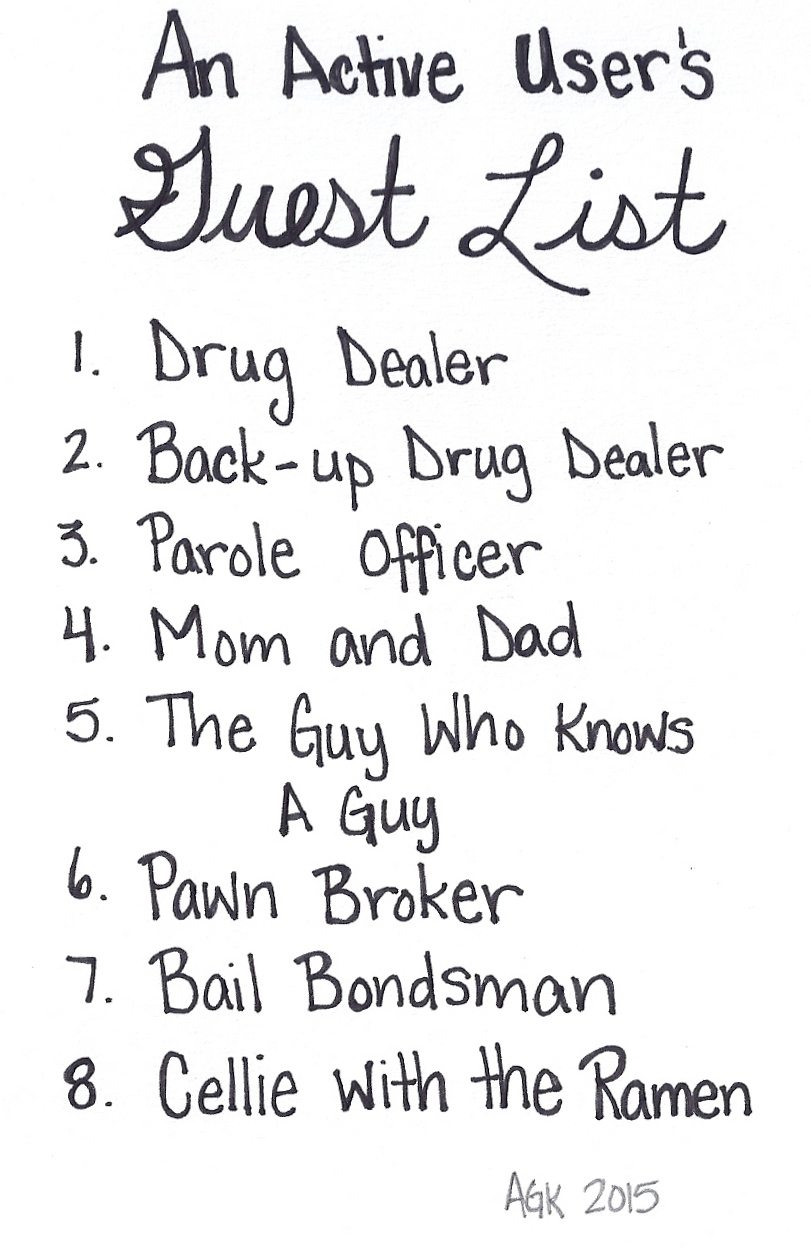
Active Addiction Guest ListAs the eight of you who read my blog regularly know, a couple of weeks ago, I got engaged to my lovely lovely. But that is not what this blog is about. This blog is about the guest list.

Eight years ago, I lived in a run-down apartment off 59 and Newcastle in Houston, Texas. My roommate, a girl I knew from work, came home one day and informed me that she was moving out. It seemed she suddenly and unexpectedly eloped with the chef at our restaurant because her student visa was running out and she was going to have to return to Russia. (No, I’m serious. I’m not making this stuff up.) She suggested either we break the lease or I find a roommate. The simple thought of living with someone new terrified me in my final days. Looking back, it is almost humorously tragic to contemplate. There was zero chance of me opening up my existence to the scrutiny and judgment of a stranger.

So, I sat on the floor of my apartment and continued to drink and chain smoke in total isolation.

Not long after, I woke up one morning in withdraws. I was dizzy and shaking. It felt like a worse version of the flu. I knew if I drank something, I would feel better, but I could not think of one person in the world who would bring me something to drink. But more than that, there is not one person in the world who would bring me anything: not a cup of soup, a blanket, or a kind word.

I often write of loneliness because it is the emotion I most remember from of those days. I was so incredibly lost and ashamed and alone. I think, honestly, I give my immediate family a bad rap in this memory. Had I called them, had I reached out and asked for help, I am sure I would have been in rehab by dinnertime. They love me and are good people, but I was so disconnected from them. My pride, even in those down times, was so entrenched it would have been impossible for me to reach out to them for help.

But that was eight years ago. This year, I will be making the promise of friendship and fidelity to another person. With that comes a wedding and a party. A few days ago, I began the amazing task of writing down a list of all the people we would like surrounding us on our special day. First I listed my family, the people who are here now that I could not let be there then. Then I listed sponsors, then sponsees, friends from our home group, ladies from my yearly retreat, buddies from his half-way house. As one piece of paper filled, I flipped the page and continued to write. I could not help but smile as our small intimate wedding soon turned into a celebration of AA proportions.

“You are going to meet these new friends in your own community… High and low, rich and poor, these are the future fellows of Alcoholics Anonymous. Among them you will make lifelong friends. You will be bound to them with new and wonderful ties, for you will escape disaster together and you will commence shoulder to shoulder your common journey,” (Big Book 152-153).

True, it is our past that originally united us. AA supplied me with a place to meet people, people who like me experience fear and neurosis, people who suffer from guilt and shame and heartache. But it is our future which will keep uniting us.

And through the process, AA has begun the process of trying to teach me how to be a friend. I’m still not very good at it. I’m still really quite self-centered. But I’m better. At least I can see my faults, apologize, and try again. Once of my favorite lines in the Twelve and Twelve is “We have not once sought to be one in a family, a friend among friends…” (53). Today, I seek to be better.

Of all the blessing I have received from AA and recovery, my friends (and my honey, of course) maybe the greatest blessing of all. I like to say I belong to the “No Matter What Club,” but if I were as lonely today as I was on February 27, 2007, I’m not sure that I would still be sober. My AA friends save my sanity on a daily basis, but more than that, they have saved my life. Now… For the rest of the journey…

The Eleventh Step Prayer

The Godsponsor“Someday, and that day may never come, I will call upon you to do a service for me. But until that day, consider this justice a gift on my daughter’s wedding day,” (The Godfather).

In my drinking days, I could never get enough of anything. I was a bottomless pit of needs and wants. I “deserved” comfort and forgiveness. I “deserved” love and joy delivered to me on a silver platter in return for all the love and generosity I supplied others. Cause isn’t that how life works? Tit for tat. I buy you dinner and next time you buy mine? I helped you with your work. Now you help me with mine. Never once was there a sincere, genuine gift made without any thought of reciprocity. No, everything had returned postage.

Lord, make me a channel of thy peace.
That where there is hatred, I may bring love;
That where there is wrong, I may bring the spirit of forgiveness;
That where there is discord, I may bring harmony;
That where there is despair, I may bring hope;
That where there are shadows, I may bring light;
And that where there is sadness, I may bring joy.

Lord, grant that I may seek rather
To comfort, than to be comforted,
To understand, than to be understood,
To love, than to be loved;
For it is by self-forgetting that one finds.
It is by forgiving that one is forgiven.
It is in dying that one awakens to Eternal Life. (Twelve and Twelve Page 99).

Therefore, that the first time I read the St. Francis Prayer (known to AAs as the Eleventh Step Prayer), I was in shock. I practically I looked around for an imaginary audience in order to say, “Do you see this? Do people do that? Do people love without love in return?” I thought that while the St. Francis Prayer may be all very good in theory, no one actually lived that way.

Occasionally, I speak to my students about how we can have gaps in our educational progress. We can get through high school, lead full, productive lives without ever fully grasping how a semicolon functions or why you can’t take a square root of a negative number.

I missed how to forgive. Looking back, I am embarrassed by how little I understood any sort of spiritual life. I was raised well. I went to church. And yet, I became a full-fledged adult who had no capacity for the faults of humanity. Instead, I had some odd philosophical, faulty wiring that told me that if I forgive people who had clearly wronged me, that I would be acquiescing my morally superior ground. Some acts are just unforgivable and if I forgive you, I have somehow lessened your sin to the level of forgivable sins. I use to like that saying, “Fool me once, shame on you. Fool me twice shame on me.” I used the spirit of self-preservation as a mean to justify hurtful behavior. But the truth is, it is easier not to talk to people than to talk to them. It is easier to be indignant than to be kind. It is easier to become hardened than it is to remain vulnerable. And it is easier to be angry than it is to forgive.

It has taken me a long time to fully understand the wisdom of St. Francis’ words. It did not come overnight. I learned from feeling others love me before I had any capacity to love in return. When I wanted so badly for someone to understand me, I learned first that I must take the time to understand someone else. It came from me making mistakes and watching others either take the path of forgiveness or non-forgiveness. And it took me asking myself which person I would rather be.

I believe in the spiritual experience of AA. I believe that God can enter a person’s heart and alter their spirit. But I also believe a person can just make the simple choice to be better. I think we can just practice at understanding. We can practice at forgiveness. And tomorrow, if I don’t get the love I feel I am deserved… well, I’ll still love ya anyways.

Lydia: Day 27

An Alcoholics Last Resort

Lydia did not know how it had happened. Well, she knew how it had happened, and yet she did not know how it happened. She knew the steps, knew the exact actions that led to her lying in a crumpled mass on the kitchen floor. What she did not know was how a seemingly innocent day could turn so quickly into a nightmare…

As part of her general dissatisfaction with her life, Lydia had started to methodically clean out the large house in Memorial. It had begun innocently enough on a lazy, Sunday afternoon. She had spent the morning reading and sipping tea, but then she turned a little restless, walking from room to room.

She eventually found herself standing in the doorway of her master closet. Once a room of pride, a space that spoke of indulgence and luxury, Lydia now looked upon the space as a choke around her neck. The designer clothes, the pristinely laid Choos and Louboutins, the large purses displayed as works of art, seemed not a reflection of affluence and ease, but a mausoleum dedicated to a former life of indulgence and superficiality. The sight disturbed her. Many of the clothes no longer even fit on her recently acquired fuller body frame, and yet there they hung.

Slowly, and with a feeling of grateful remorse to a past life, she carefully folded and packed away shirts after pants after skirts after cocktail dresses after ball gowns of clothes, once lovingly purchased and adored.

When Lydia finished her room, she moved on to her son’s and then her daughter’s. With each macramé school project and participation trophy, with each seashelled vacation souvenir and mother’s day card, a fond memory was ignited, appreciated, and then quietly closed. The items she did not feel were worthy of keeping, she threw away with no regret. With each passing garbage bag, she felt lighter, freer. The nicer items, the things she thought the kids might honestly want, Lydia set aside in one of two piles. If they wanted them, they would have to come get them. But her and Henry’s house, her house, would no longer be the exoskeleton of a time past. Lydia was living day by day, step by step, and all she wanted was for her surroundings to reflect her new founded simplicity.

So, it was with some confusion that it was a simple sweatshirt that had paralyzed Lydia that Sunday evening. A sweatshirt. Any other day, she might have simply folded it and placed it in his dresser drawer. Old, frayed around the edges, but perfectly worn in. When she and Henry first started dating, Lydia had confiscated the sweatshirt as a form of territorial display. She would wear it up to the hospital and kiss him in full view of the nurse’s station. Not usually a woman prone to jealousy, she knew from her own stay in the hospital that Henry was often sought out and flirted with. Lydia was not going to let him fall through her fingers. She was determined to fight for him, fight for him in the best way she knew how, in his Colombia sweatshirt and a tight pair of jeans.

But it was in that moment, in the moment when she raised the sweatshirt up to her nose to inhale his scent that she realized she had not fought for him. She had given him away, pushed him aside as she reached for another bottle. She blamed him. She accused him of desertion, but really, she the one that deserted him. She may have physically been there, but her mind was always fighting and struggling somewhere else. In her heart, in that moment, she could not blame him for leaving.

She looked up and straight into the sideboard mirror. The reflection startled her, for the woman who stared back was not the woman she had expected to see. She had looked in mirrors; she had to have. Always a woman properly put together, Lydia had spent hours applying make-up and coifing her perfectly styled hair. So, she must have look. But had she really looked? Lydia moved closer to the mirror, placed her hand against the cool glass. There, staring back at her was not the dignified and beautiful woman she envisioned, but an aged woman, worn and creased. Her hair, thought by her to be golden and lustrous, was a dried and brittled bleach. Her face was puffy and yet somehow simultaneously drawn. There were circles under her eyes. Her skin had a yellowed hue, the color of prolonged sickness and self-tanner. Instead of cathartic recovery gravitating through her arterial system, a wave of bile, anger, self-loathing, disgust, and hated swelled up from her stomach.

Without warning alcoholic desire screamed at her. It knocked her body backwards with a physicality that forced her to break eye contact with the mirror. Suddenly clinging at the neck of her t-shirt, she couldn’t breathe. She doubled over, trying to catch her breath. After a few seconds, Lydia looked up and ran from the room, the sweatshirt lying on the ground.

She sprinted down the sweeping spiral staircase to the living room. When she got there, she looked wildly around. Think, think. The bar wouldn’t have anything. She had cleaned it out. Think, think. The cabinet above the refrigerator! Lydia pulled over a counter stool and stood on it to reach one of her most favorite hiding places. None. The pool house! Lydia ran to the guest quarters and pulled open the refrigerator, once stocked for parties, only to find it barren. The outdoor kitchen. No.

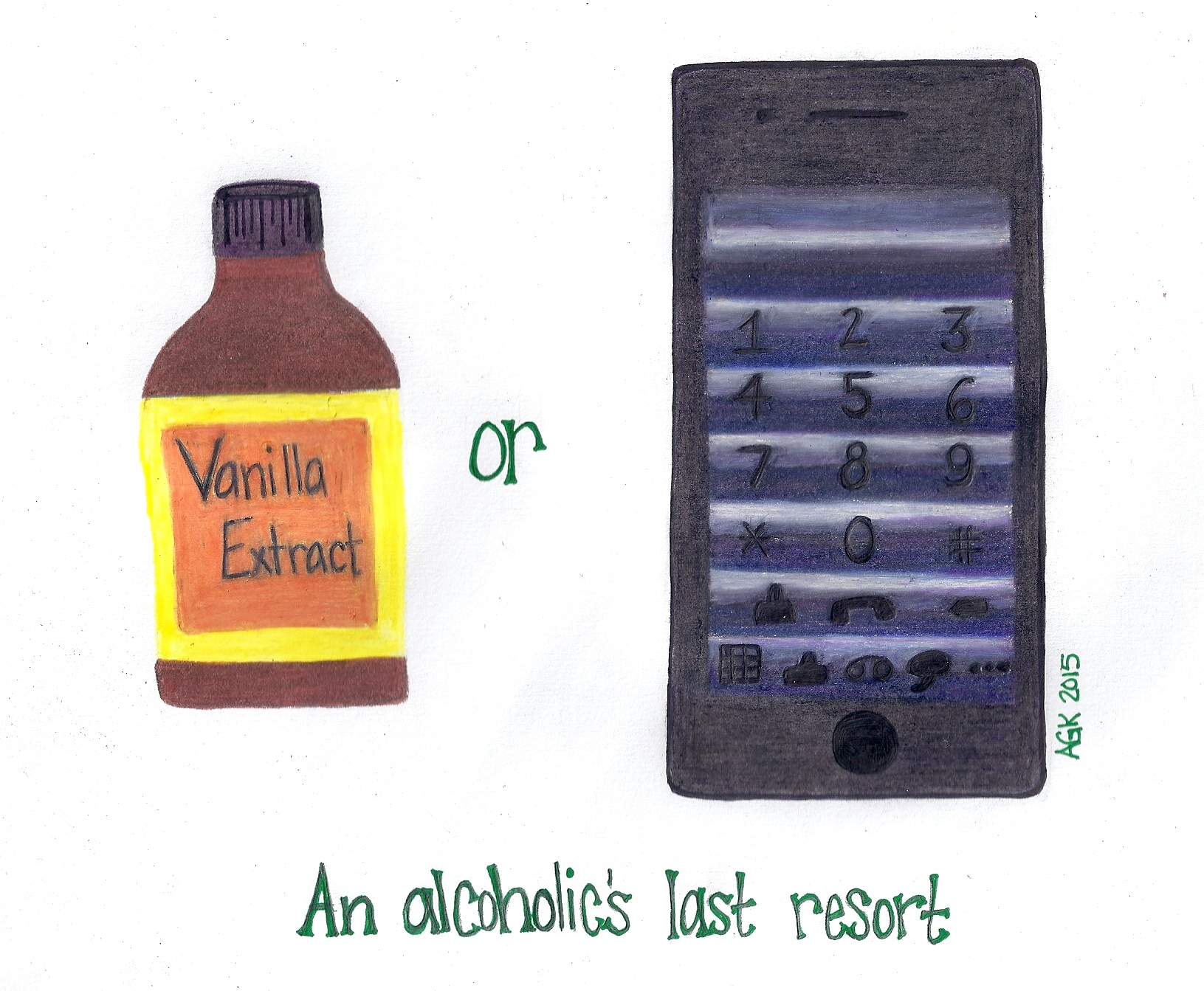
Panic overcame her as she ran back to the house and furiously started pulling out drawers and looking in behind furniture. She couldn’t have gotten it all. She must have forgotten something, overlooked something, anything. Lydia ran to the kitchen. Sherry, cooking wine, something. Lydia spotted the bottle of vanilla extract. She grabbed it off the shelf. She held it tight in her palm and looked down at it. 35% alcohol. It would work. It would quiet the thoughts until she could get to the store. And then it clicked. In a moment of realization, Lydia realized she was of the variety of alcoholic that would drink vanilla extract. She closed her fingers around the bottle and sank to the kitchen floor.

The Most Satisfactory Years of [Our] Existence Lie Ahead.

Self PortraitA couple of years ago, through a series of unusual events, I found myself swimming along with my aunt in the sea off the coast of Cancun. My aunt, the wife of a Lutheran minister, is an incredible woman of natural spirituality and grace. So, we were bobbing along in the ocean, talking about life when she said, “It must be interesting to have a relationship where from the beginning, you each knew the worst thing about the other person. So many times, people in relationships try to cover up and hide the worst parts of themselves, hoping the other person will not see it.”

I’ve thought about that sentiment many times over the last couple of years. It is true. When I had two years sober, I got my very first apartment all by myself. Up until then, I had lived in sober living. I was struggling. I had those thoughts of “If I drank, no one would know.” And it scared me. One night I found myself at a ten o’clock meeting. In short time, I found myself comfortably sharing in the quiet dim of the candle light. Free from imagined judgment, I was able to share my deepest insecurities and fears.

It was in this setting that my love and I spent many months sitting across the room from each other, before we ever went for our first cup of coffee. In fact, if you asked him, he would readily admit that he originally felt sorry for the poor, lost girl who didn’t believe in God. What I remember about those times was his honesty in admitting his social anxiety and how we both bonded over our shared hatred of driving. (I do most of the driving now. I figured living in Houston, one had to work through this fear. He’s fine with letting me process my recovery as he sits in the passenger seat.)

I’ve had a lot of conversations with lot of different women over the years regarding whether or not one should date within the program. I know many people who are attracted to the idea of dating a “normie.” I get that. I get the idea of swaying away from the fear of potential relapse and the emotional baggage that follows in the wake of any given alcoholic. “But it is from our twisted relations with family, friends, and society at large that many of us have suffered the most. We have been especially stupid and stubborn about them. The primary fact that we fail to recognize is our total inability to form a true partnership with another human being,” (Twelve and Twelve page 53) Trying to align oneself with a narcissistically immature misanthrope can be a bad idea.

Yes, there is something to my aunt’s words; we do know the worst about each other. But we also know the best. I know my sweetie wakes up each morning and prays. I know at some point in the day, he will read and meditate and go to a meeting. I know he will talk to another alcoholic and ask that man for a slice of wisdom. I know he will help someone.

And I know with my sweetheart, I never have to apologize for working my own program. I never have to procure a reason for going to a meeting. A sentence like, “I’m going to call my sponsor,” doesn’t send him into a spiral of insecurity. Saying, “I’m crazy and I don’t know why” or bursting into tears for no reason doesn’t require really any more explanation than that. Cause he knows why. I’m an alcoholic and some days are just like that.

Our love is predicated not on fear of relapse but on the combined spirituality and growth that active recovery ensures. I can tell you in all honesty, we are better people today than we were five years ago when we met. Over time, some of the anger, jealousy, and fears have subsided. We have worked through abandonment issues, monetary insecurity. When we argue, phone calls are made and inventories are taken (our own, not each other’s). We look at our character defects, apologize, and make honest attempts to do better next time. But y’know, it is not even how far we have come that calms me; it is the thought of how much more we have to grow. I look forward to seeing what will become of us, for I am sure, “The most satisfactory years of [our] existence lie ahead” (BB 152).

On January 8th, Bob got down on one knee and asked me to marry him. I said, “Yes.”


Lydia: Day 22

Powerless

It had been a week since Lydia had asked Tracy to sponsor her, and even though she had no idea what the role of a sponsor truly was, she relinquished as much as she could to the idea of vulnerability. Tracy had insisted that Lydia call her every day. At first, the conversations had been awkward and stilted. While she had many women friends in her life, Lydia had never been one to share intimate details about herself or Henry. It only took a few phone calls, though, for her to realize that Tracy was not intending on being her friend, but rather something more altogether. Their conversations were sometimes short and sometimes long, but they always focused on recovery, the steps, and emotional sobriety. Lydia tried her best to answer Tracy’s questions honestly, but sometimes Tracy’s observations cut Lydia to the quick. Never had she felt so shallow as when she reflected Tracy. It only took a matter of days for Tracy to earned her trust.

In one of their initial conversations, Tracy had given her a short list of things to do, and so far, most had been accomplished.

The first item on her list was to read the Big Book of Alcoholics Anonymous. Lydia had already bought a Big Book a couple of weeks before. Normally a voracious reader, on a good day she could easily polish of an entire Danielle Steele or Barbara Cartland novel. But this book was different. If Lydia concentrated, thought really hard, she could make it a couple of pages before her mind wandered to what she might find on TV. Maybe it was the language. Maybe it was the subject matter. She didn’t know why, but most of what Bill Wilson wrote about was completely lost on her.

The second item on her list was to attend an AA meeting every day for ninety days. Although she had attended a meeting everyday for the last 22 days, sometimes two or three, the idea of ninety somehow seemed ridiculous. Lydia tried to argue this fine point with Tracy, but her sponsor seemed to have none of it.

Finally, Lydia was to begin her stepwork, the point that had brought her to her granite countertop on a Tuesday morning with a steaming coffee cup of green tea neatly positioned at a forty-five degree angle to a new journal, bought from Barnes and Nobles and bound in antiquated brown leather. Lydia had even bought a special fountain pen to record every piece of her step work. She wanted it just so. Even though she had only been sober a short while, Lydia looked forward to the day when she would have her own sponsee. When that time came, she wanted to be able to tell the girl that she worked her steps perfect.

On the first page, Lydia had neatly scrawled, “important phone numbers.” On the second page, she had neatly begun a list of goals. The list included running a marathon and writing a book. She even thought about returning to school, maybe getting a degree in psychology or addiction counseling.

But it was the top of the third page of the journal that had Lydia had become stuck. At the top, she slowly retraced the word powerless in the line, “1. Admitted we were powerless over alcohol and that our lives had become unmanageable.” On some base level, Lydia knew she could not drink anymore, therefore the correct answer simply had to be alcohol. And yet, the word powerless seemed more perplexing than that. If, she though, the line had instead read, “Admitted we were alcoholic and that our lives were unmanageable,” the answer would be more direct, simpler. She could admit she drank too much. But powerless. What did that mean? She wasn’t powerless against alcohol. She had a house and a life and, at least for the time being, a husband and a family.

After a few minutes, Lydia moved her pen down from the word powerless and slowly wrote, “Alcohol.” With a sigh, she set down her pen and closed the book.

5 Sober Activites Worth Remembering January 2nd

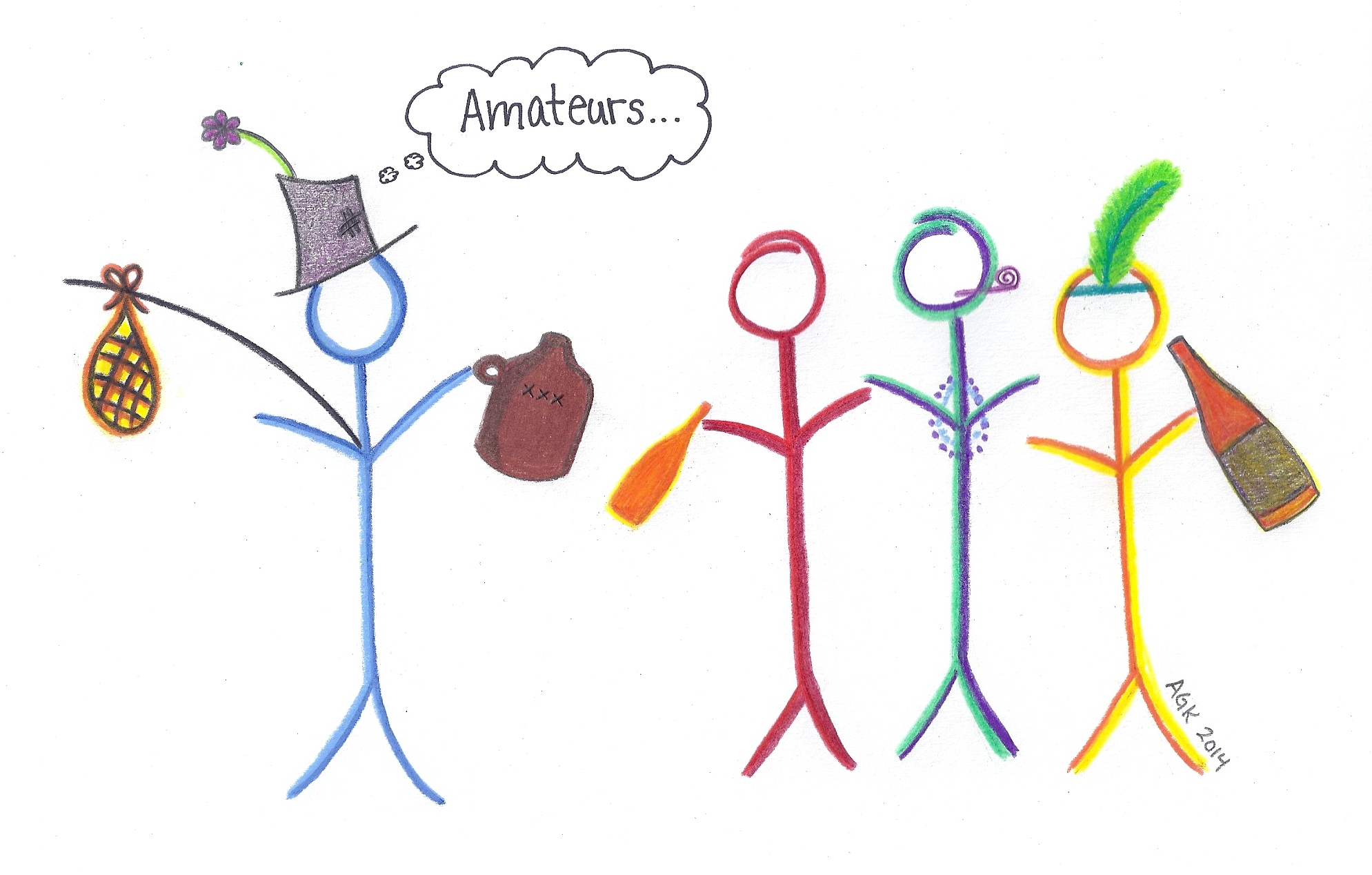
Amateur Night

New Years is one of my favorite holidays of the year. I think it is about the closest normies ever get to working the program. I mean, let’s admit it; there’s the reflection on past, the admission of shortcomings, and an somewhat earnest attempt to change the negative aspects of their personality or physique. From a young age, I was drawn to this idea (or maybe I was just drawn to New Years because it’s the only holiday based on the self-centeredness.) Anywho, when I got sober, I thought the days of the New Year celebration was over. Little did I know….

So, without any further ado: five ideas for New Year’s celebrating, old school style.

Go Dancing!: I heard a great story once when a friend of mine was getting married. The wedding planner, a woman baffled by sobriety, made the comment that no one was going to dance if there wasn’t any alcohol served. My friend answered something to the effect of, “Well, you haven’t met my friends.”

I honestly think dancing sober is high on AAs list of fears. It only took me one boy-girl dance in middle school, awkwardly dancing in a circle with my friends, to know that sober dancing, for me, was never, ever going to happen. I was a club hopper in my day, but it always took an insane amount of liquid courage to get me out on the floor. So, when I got sober, I naturally thought I had to hang up my dancing shoes.

But then I went to a sober dance. My friends dragged me over to North Wayside on a Saturday night. I was amazed by the sheer number of people out there in the dance floor, cutting a rug, and having a great time. It immediately took all the fear out of the situation for me.

Many AA clubs sponsor sober dances for New Years, and many of those are free. So, grab your nearest sober buddy and have a blast!

Movie Marathon: This one stemmed from a recent conversation I had with my brother. I have never seen Star Wars 4, 5, 6 (Or is it 1,2, and 3? Whatever, the new ones). I feel this is a major gap in my cultural education. I can’t tell Mozart from Bach and I haven’t ever seen the new Star Wars. So, this New Years, I am going to sit down and see arguably the greatest movie I’ve never seen. So, I pass this on to you. What movies are on your bucket list? The Caine Mutiny, The Godfather, Gone with the Wind? Put your feet up, pop the popcorn, and watch away.

Clean House: In my super early days of sobriety, I kept hearing people talk about the importance of “Cleaning house.” I didn’t really understand it. I went home and thought, “They want me to clean my house?” I spent the rest of the night scrubbing down my apartment. Since then, I’ve clearly learned that “cleaning house” is a metaphor for the spiritual inventory that comes from getting down to causes and conditions. But still, in my head, the two cleanings are linked.

My mom always says, “If you haven’t worn it in a year, you’re not gonna wear it.” Throw it out. Donate your clean, slightly used clothes to a women’s halfway house. These women often need clothes befitting their newly sober lifestyles. Additionally, I’ve seen first-hand what perfume and nice bath products like Bath and Body can mean to a newly sober women. These items take on a whole, new level of luxury because many of these women have been struggling so long just to survive, that they have forgotten entirely about small gifts of beauty. Clean out your bathroom closet. Make a nice care package and deliver to a woman’s shelter. This may not be the funnest thing on my list, but I promise you, you’ll feel great afterwards.

Get a Makeover: It’s 2015! Halfway to 2020. Time for a contemporary haircut and some fresh makeup to get you ready to tackle new adventures. Don’t go for the same old same old. Don’t stick with the usual. Go to a new hairdresser and let them choose the style they think would be the most flattering on you. Let go of the control. Then walk over to the Mac make-up counter and ask for a makeover. It’s free. This is not time to play it safe. Let the girls to do it up, and while a Mac makeover can be a bit much for everyday wear, I guarantee you by the time it is over, you will feel awesome. Then buy the florescent blue eye shadow, even if you only wear it in the house on Sundays. Afterall, just because you are sober does not mean there isn’t still a little rocker left in you.

Game Night: Game nights are an opportunity to get together with one’s closest friends and make complete fools of ourselves. Over time, I’ve come to the decision that game nights not only work best with an even number of people, but one needs a variety of fun games and ridiculously junky food. So, call your friends up and invite them over. Tell each one of them to bring their favorite game and their junkiest appetizer (Remember! Resolutions start the next day!) Proper game nights are not for the faint at heart. Get the mini frozen eggrolls and fried cheese. Put the RedBull on ice. Have the stogies at the ready). My favorite games for groups are Taboo, Pictionary, and the old standby, Trivia Pursuit.

There is a total misconception that once we stop drinking, fun has to end. The truth is, AAs are by and large a ridiculous fun and stupidly adventurous group of individuals. Whether its New Year’s skydiving or Polar Bear swimming off Galveston, someone’s bound to be doing it. All you have to do is make a few phone calls. And the greatest thing about whatever it is you do this year? You’ll remember it Jan 2nd.

Happy New Years!

The Path

Turning Over a New Leaf

I know I haven’t met you yet,

But I’m positive when I do,

We will greet each other like old friends.

I’ll extend my hand to you.


But until that future time comes,

I can only wish you well.

Cause the road you travel down

Is a solitary hell.


Littered with tears and pity,

Shame and sorrow at your side,

You keep trying the same old game again.

The Devil’s in your pride.

                                                                                                                                                                                                                                                                                                                 So, keep walking down that path you made.

Walk it all alone.

Because you need to fully feel,

The existence you have sown.


But when you reach the point,

Of choosing life or death.

I hope you will reach out for help

With surrendered breath.


For though I walk another path

Your history rings true.

To the very path I used to walk,

Because I was once just like you.